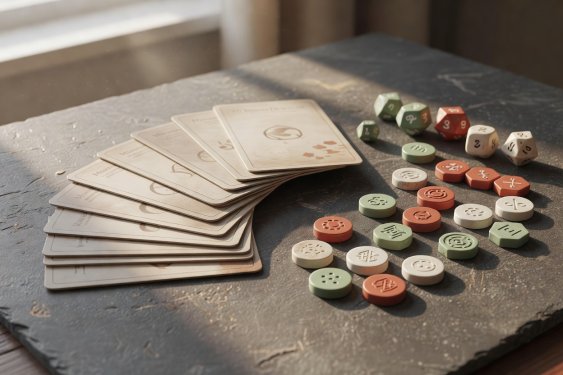
Learning familiar tabletop formats

Moving from simple party games to genuine modern board games does not require a 40-page manual. Focus on tactile, intuitive mechanics like drafting, route building, and domino placement.

Entry Point: Gateway Tabletop Turn Overhead: Under 30 Seconds Tactile Satisfaction: High

What makes a modern format welcoming?

New tabletop players are often startled by the physical beauty and variety of modern game pieces: chunky wooden dice, pastel scoring markers, linen-finish cards, and laser-cut tiles. But visual charm means nothing if the underlying turn mechanics cause cognitive overload.

The best introductory tabletop formats share three indispensable qualities:

  • Tactile Simplicity: On your turn, you touch or move only one or two physical objects.
  • Spatial Legibility: Anyone walking past the table can instantly see who is collecting what, with no hidden calculation ledgers.
  • Gentle Escalation: The game starts with minimal options and gently opens as your board expands.

Three modern entry-level classics compared

Each of these universally acclaimed titles introduces a foundational tabletop mechanic without overwhelming rules friction.

Soft-lit render of sushi go style colorful cards
Drafting Mechanic

Sushi Go! (or Party)

Teaches "pick-and-pass" drafting. Everyone selects one card simultaneously, reveals it, and passes their hand to the left. Zero downtime: all players make decisions together, eliminating the wait for slow turns.

Rounds: 3 fast courses Teach: 3 min
Soft-lit render of wooden kingdom domino tiles
Tile Placement

Kingdomino

Uses the timeless concept of dominoes to build a 5x5 kingdom of wheat fields, lakes, and forests. The scoring math (crowns multiplied by matching terrain squares) is visual, tactile, and immediately grasped.

Time: 15–20 min Teach: 2 min
Soft-lit render of train car tokens and destination cards
Set Collection

Ticket to Ride

The gold standard of modern board games. On your turn, you simply pick coloured train cards, spend cards to claim a railway line on the map, or draw more route tickets. That three-action simplicity keeps the pace brisk.

Time: 45 min Teach: 4 min

Avoid the "Just One More Exception" trap

When someone asks during a rules explanation, "What happens if I have no matching cards and two wildcards while running out of deck?" resist the urge to deliver a five-minute sermon on contingency rules. Respond: "If that happens later, we will solve it together in five seconds. For now, let's play round one."

Picking the right weight for your table

A quick reference to evaluate table time and complexity before opening the box.

Game Format Core Mechanic Player Range Downtime Level Key Social Vibe
Sushi Go! Simultaneous drafting 2 to 5 (up to 8 in Party) Near Zero Breezy, competitive card hoarding, snack-friendly
Kingdomino Tile placement & drafting 2 to 4 Very Low (15s/turn) Quiet spatial puzzle, satisfying visual board
Ticket to Ride Set collection & routes 2 to 5 Low (20s/turn) Classic travel adventure, visible board tension
Letter Jam Cooperative word deduction 2 to 6 Moderate Deliberate, thoughtful teamwork around letters
Next: Balancing Large Group Teams →